
Miss Odessa: Building a Voice AI Guide to Montgomery's History Buses
How MMI built an original voice AI character to guide families through three historic buses at the Rosa Parks Museum, and the rules that made it work.
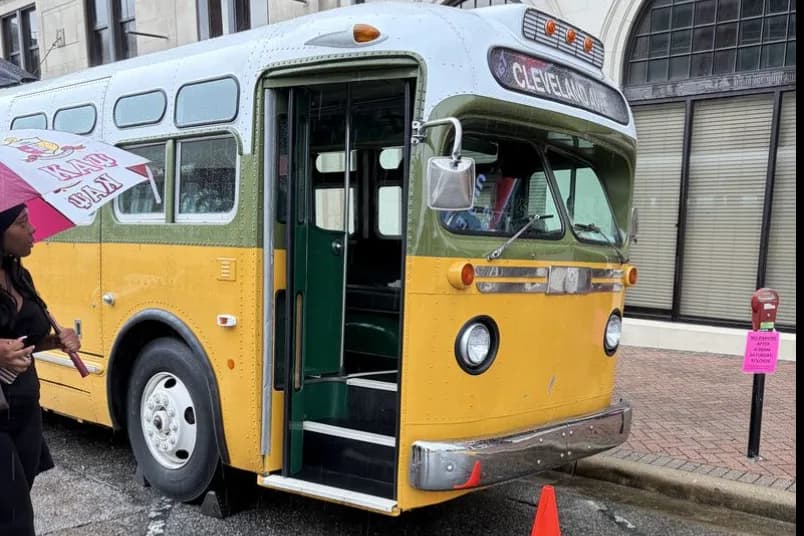
Three historic buses, a rainy Saturday at the Rosa Parks Museum, and a phone number anyone could call to ask about what they were looking at.
It rained on the Saturday of the block party. The buses were there anyway.
A 1950s Montgomery city bus was parked on the grounds of the Rosa Parks Museum. Next to it, a Freedom Riders bus. Next to that, a bright modern Boost Bus. Families walked between the three, and on a sign by our tent there was a phone number. Call it, and a warm Southern voice picked up, ready to talk about the buses.
That was Miss Odessa.
Who she is
Miss Odessa is a retired Montgomery schoolteacher in her seventies. She is also entirely made up.
We built her for the Community Boost Block Party, a free family event put on by Culture In Motion, the Apollo Theater and Kwanza Jones roadshow that brought the buses to town. The organizers offered MMI a spot as a featured community contributor. We did not want to show up with a table of brochures. We wanted to bring something people could use while they stood there.
So we built a guide. Not a chatbot that answers anything, and not a recording. A voice you could talk to about the three buses in front of you, in plain language, at whatever level you wanted. A ten year old could ask what the Freedom Riders were. A grandparent could ask what route the city bus ran. Both got a straight answer from someone who sounded like she had lived here her whole life.
The rules came before the code
This is where most AI demos go wrong. They start with the technology and work out the boundaries later. We did it the other way around, because the subject was civil rights history, on the grounds of the Rosa Parks Museum, in front of children. The boundaries were the product.
She is a guide to the buses. She never speaks as a bus, and she never pretends to be a person who was there. The organizers were clear on that point and they were right.
She does not impersonate anyone. The voice is an original design, not a clone of any real person. Early on we talked about whether a historical voice would be more powerful. We decided quickly that it would be wrong, and dropped it.
She only knows what we gave her. Every answer traces back to a vetted set of Montgomery history sources that we put together and offered to the organizers for review before the event. If a question falls outside that set, she says so and steers back to the buses.
Nothing personal goes in. No names, no phone numbers, no sign-ups. Visitors ask, she answers, and the conversation ends.
Strictly non-commercial. Miss Odessa does not pitch MMI. If someone asked who made her, the most she would say is that she was made by Montgomery folks who love this city.
Those five rules are the whole design. The AI part was the easy half.
How we built her
Miss Odessa runs on ElevenLabs conversational voice, with a voice we designed for her and a persona document that sets out how she talks, what she knows, and what she refuses. Her knowledge is organized by topic and not by vehicle, so if the lineup of buses had changed that morning she would still have made sense.
We shipped her two ways.
The first was at the tent: a laptop and a microphone, where we controlled whose turn it was to speak so the crowd noise did not set her off.
The second was the phone. The same agent, connected to a real phone number through Twilio, printed on a sign and live all day. Call the number, Miss Odessa picks up. That second way in mattered most, because nobody had to wait in line or lean into a laptop. You could stand next to the Freedom Riders bus and call.
We also built an offline backup and tested it beforehand, in case the connection at the venue failed. It is not glamorous. It is the difference between a demo and something you can put in front of the public.
Why this matters beyond one Saturday
Everything we build for businesses follows the same pattern as Miss Odessa. Decide what the system is allowed to know. Decide what it is never allowed to do. Give it a voice and a personality that fit the people it serves. Put it on something people already use, in this case a phone number. Test how it fails before anyone sees it.
A museum guide, a receptionist for a dental office in Prattville, an after-hours line for an HVAC company in Wetumpka. The constraints differ. The discipline is the same.
If you have a place, a collection, or a business that people have questions about, and you want those questions answered well by a voice that fits, that is work we know how to do. Get in touch and tell us what people keep asking you.