
What You Can Ask AskMGM: Montgomery's Open Data in Plain English
AskMGM answers plain-English questions about Montgomery, Alabama from 45 public city datasets. What you can ask it, what it is good at, and how to ask better questions.
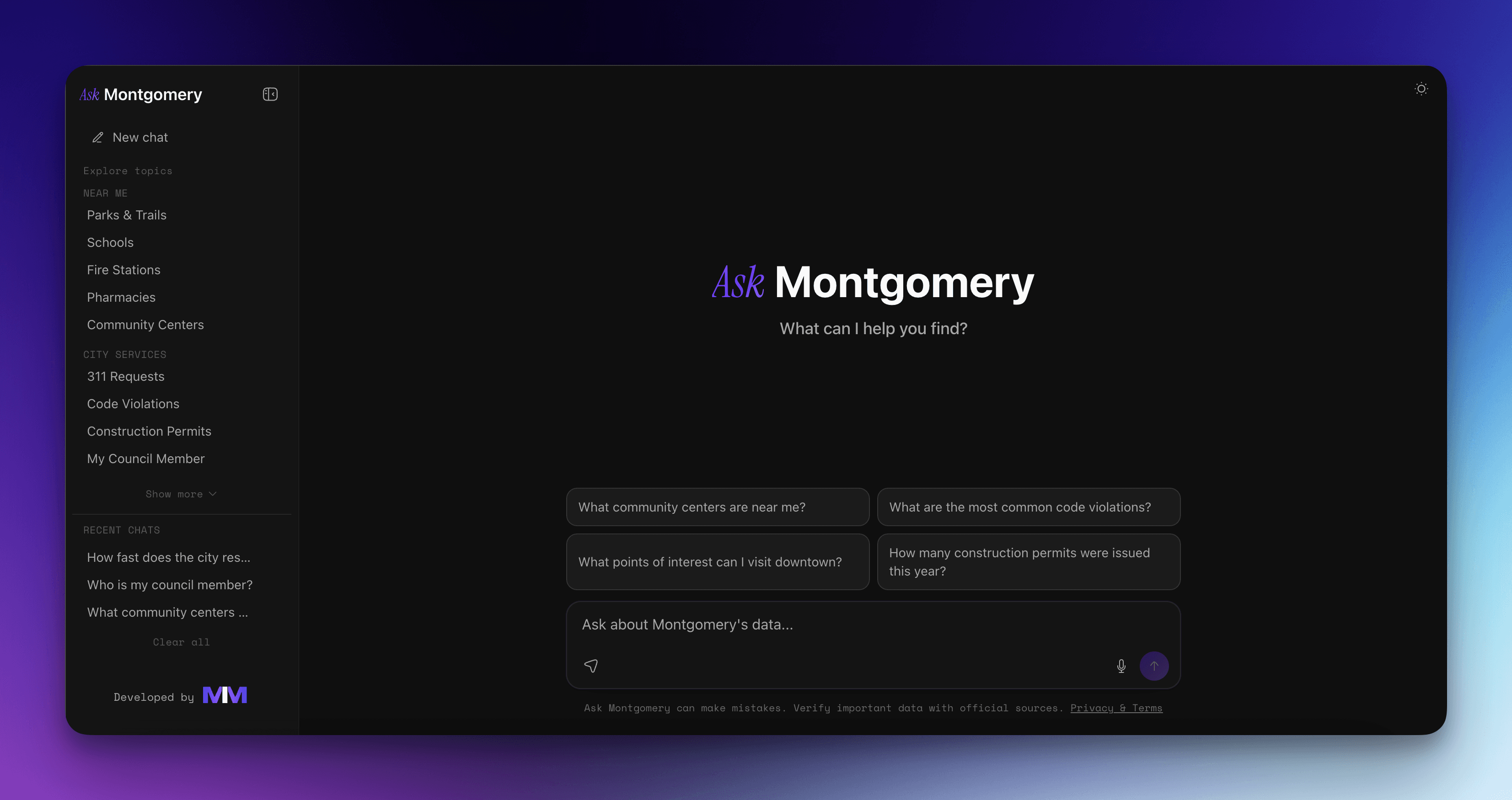
Montgomery publishes a lot of data about itself. AskMGM lets you skip the spreadsheets and just ask.
When's my garbage pickup? What zoning is this address? Where's the nearest fire station?
Those are ordinary questions about living in Montgomery, and the answers are public. The city publishes them. They are also buried in dozens of datasets on an open data portal built for engineers, where finding one answer means downloading a spreadsheet, working out what its columns mean, and knowing which of forty-five files has the thing you want.
AskMGM exists so you can skip all of that and just ask.
What it is
AskMGM is a free civic tool MMI built and runs for Montgomery. You type a question in plain English. It works out which of the city's 45 public datasets can answer it, writes and runs the query, and gives you the answer with the data behind it.
The datasets are refreshed nightly from the city's ArcGIS Hub, so the answers track what the city publishes. We also publish the cleaned datasets on Hugging Face under the mmintelligence organization, for researchers, journalists, students and anyone else who wants the raw material.
It is not for sale and it is not a pilot. It is simply out there for residents to use. We wrote up how we built it separately.
What is in it
The data covers the things a city keeps records on: building permits, code violations, 311 service requests, business licenses, fire rescue incidents, civic facilities, and council district boundaries, among others. All of it comes from the City of Montgomery's Open Data Portal and ArcGIS Hub.
People do not ask about datasets, though. They ask about their street, their neighborhood, their situation. The tool's job is to translate.
What it is good at
Questions with a location. Anything that starts with "near," "on," or "in" works well, because most of the city's data has coordinates and the system knows how to use them.
Questions with a count or a comparison. How many, which has the most, how does this area compare to that one.
Questions about a specific record. A permit number, an address, a facility name.
What it is not
AskMGM only knows what the city publishes. If a dataset does not exist on the portal, the tool cannot invent it, and it will tell you so instead of guessing. It is not a search engine for Montgomery news and it does not know about anything that happened this morning. It answers from the data, shows you the data, and stops.
How to ask better questions
Be specific about place. "Parks in Montgomery" returns a long list. "Parks within a mile of Cloverdale" returns something you can use.
Say what you want to do with the answer. "Show me code enforcement cases on my street" gets a list. "Which streets in 36106 had the most code enforcement cases this year" gets an answer.
Ask a follow-up. The tool keeps the context of your conversation, so "which of those have playgrounds" works after a parks question.
Why we built it
Most of what MMI builds is for businesses and institutions, and most of it is private. AskMGM is the public version of the same work: take data that is technically available and practically unusable, put a plain-language way in front of it, and make sure it answers from the source and not from thin air.
If your organization has data that your own people cannot get answers out of, that is the same problem, and we know how to solve it. Get in touch.
Try it at askmgm.com.