
Two Days, Idea to Pitch: Mentoring Innovation Weekend at The Eagle Institute
AUM and The Eagle Institute gave River Region students one weekend to build a trustworthy AI agent. We opened with the ways agents go wrong, then mentored the teams. Here is what stood out.
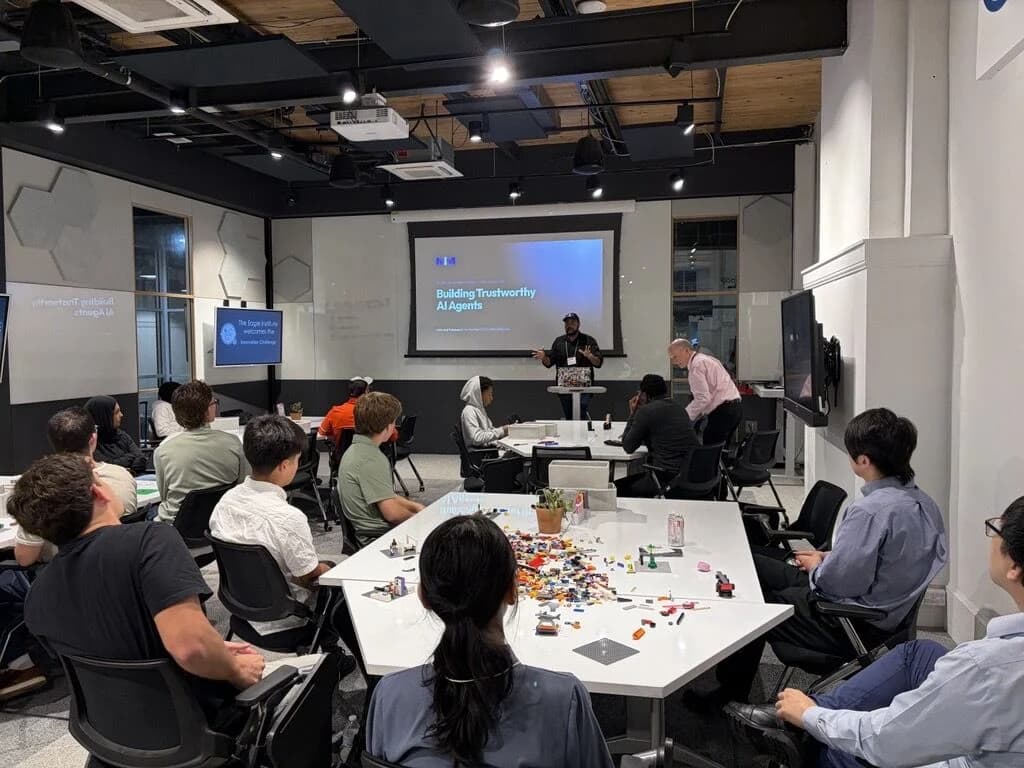
Two days. Idea to pitch. And most teams walked in on Sunday with a working demo.
Innovation Weekend is a student challenge run by Auburn University at Montgomery's College of Sciences with The Eagle Institute, Air University's innovation space in the old Kress building on Dexter Avenue. The brief this year was narrow on purpose: build an AI agent for a setting where being wrong has a cost, and make it one people could trust.
Students came from AUM, Faulkner University, and Trenholm State. They got two days. Then they pitched.
We were there to open the weekend and to mentor. Here is what we saw.
We started with the failures
Our opening talk was not about what AI agents can do. It was about the ways they go wrong in practice, with real cases: an agent that confidently answered a question nobody asked, a workflow that worked in the demo and fell over on the first odd input, a handoff to a human that dropped the call. Each one came with the same question: what would you have checked before shipping this?
That framing mattered. The teams went into the build with a list of ways to fail already in their heads, which turned out to be the most useful thing we could give them.
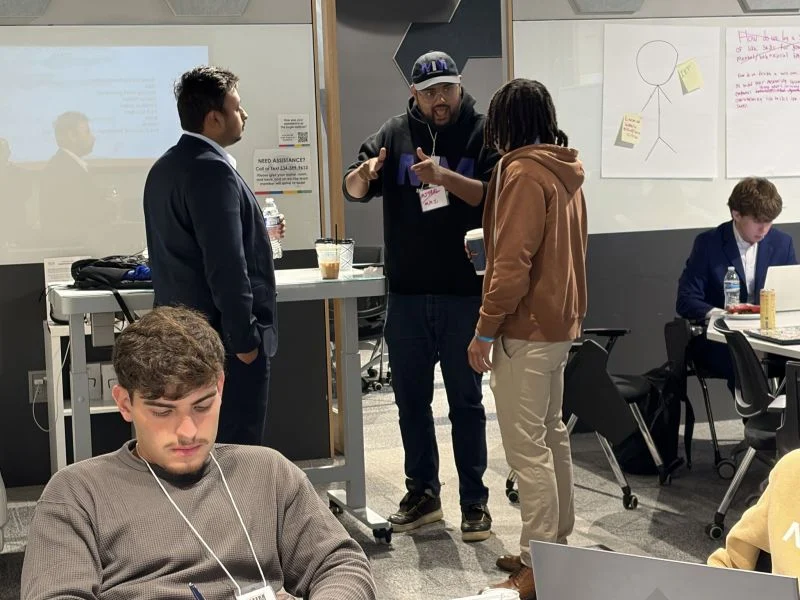
The questions were better than the tech
The thing that stood out was not the models or the tools. It was what the teams asked.
They were not asking "where can we add AI to this?" They were asking whether the problem actually needed AI at all, what happens when the agent is wrong, and who checks its work. Those are the hard questions. A lot of professional teams skip them. These students did not.
Several groups cut features partway through because they could not answer "what happens when this is wrong" to their own satisfaction. That is the right instinct, and it is rare.
They moved fast
By the pitches, most teams had a real interface and a live demo, not a slide deck describing one. Two days is not much time. Watching students go from a whiteboard to something you could click on, with a human-in-the-loop step they had thought about, was the best part of the weekend.
What we would tell the next cohort
- Pick the smallest problem that matters. The teams that scoped tightly at the start had working demos at the end. The ones that tried to solve everything were still arguing about scope on day two.
- Decide what the agent never does. The boundaries are the product. Write them down first.
- Build the escalation before the happy path. If the agent can hand off to a person cleanly, every other mistake is recoverable.
- Demo on real input. The first odd input will find the bug that your own test data never would.
Thank you
To Jeremy and DeVanté Snell at The Eagle Institute for building a weekend like this, to Dean Douglas Leaman and the AUM College of Sciences for backing it, and to every student who gave up a weekend to build something. Montgomery's next generation of builders is already here.
MM Intelligence builds AI voice agents, automations, and custom software in Montgomery, Alabama, and mentors and teaches across the River Region. If your school or program wants a hand with a build weekend, talk to us.